Freeze-Thaw and Concrete in Western Colorado: Why Overlays and Sealers Matter
Water is the quiet enemy of every slab, and a protective surface layer is how you keep it out.
October 27, 2026 · 4 min read
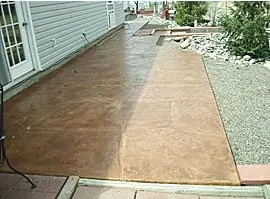
If you have lived on the Western Slope for a few winters, you know the pattern. A cold night, a bright day, a thaw, another cold night. The sun on the south side of the house melts the frost by lunchtime, and by dinner it is freezing again in the shade. That back-and-forth is rough on a lot of things, and concrete is near the top of the list.
Understanding why helps you make better choices about what goes on top of your driveway, patio, walkway or garage floor.
How freeze-thaw damage works
Concrete looks solid, but it is not sealed against water by nature. The surface has tiny pores, and any hairline crack is an open door. When rain or melting snow gets in and the temperature drops, that water freezes. Ice takes up more room than liquid water, so it pushes outward on the concrete around it. When it thaws, the water moves, and the next freeze does it again.
Small cracks grow bigger. The top layer begins to flake or scale off. Edges chip. A slab that was only faded and a little rough one year can look noticeably worse after a few more winters. None of this happens overnight, which is exactly why it gets ignored until the damage is obvious.
The surface layer is the first line of defense
Because the problem starts with water getting in, the most useful thing you can do for concrete is control what happens at the surface. That is the job of a good sealer or overlay. A sealed or overlaid slab does a better job of shedding water instead of soaking it up, and a continuous surface layer gives water fewer places to enter.
Color Country Resurfacing, based in Grand Junction, applies strong, super-durable concrete overlays and sealants over concrete or any masonry surface. According to the company, its overlays have excellent freeze-thaw characteristics, and they are suitable for home, commercial and industrial surfaces. That matters here, because a finish that looks great in July has to survive January too.
Where it matters most around your property
- Driveways, which take weather, tires and de-icing products all at once
- Entry walks and steps, where a slippery or flaking surface is also a safety issue
- Patios, which sit under open sky and collect water and snow
- Garage floors, where snow melts off vehicles and sits on the slab
- Pool cooling decks, which are wet by design and stay in the weather
All of those surfaces are on the company's resurfacing list, along with concrete floors and concrete leveling, which is included in their work.
Traction and winter safety
A surface that sheds water also needs to be safe to walk on when it is wet or frosty. That is why the finish matters as much as the protection. Options include a broom finish that adds traction, anti-slip additives, and smooth or brushed textures when a different feel is the goal. A smooth finish looks clean in a garage but may not be what you want on the walk to the front door. Think about who uses the surface, in what shoes and in what weather, and pick the finish to match.
Small habits that protect any slab
Whatever the surface, a few simple habits extend its life. These are general good practice and not a replacement for advice from your installer.
- Keep water moving away from the slab, with downspouts and grading that do not dump onto it
- Sweep off debris and standing leaves, which hold moisture against the surface
- Shovel snow rather than leaving it to melt and refreeze in place
- Ask your installer which de-icing products they recommend for your finish, since some products are harder on surfaces than others
- Deal with new cracks early, before water has a winter to work on them
Why waiting costs you options
A slab with surface wear is a good candidate for resurfacing. A slab that has been allowed to break up through repeated freezing may have moved past what an overlay can fix. That is the reason it is worth looking at a worn driveway or patio now rather than after another hard winter. Chipped, cracked and faded concrete usually has more than one thing wrong, and the earlier it is looked at, the more choices you have.
Resurfacing also brings the chance to improve how the surface looks. Since the work is going on anyway, you can choose a color matched to your home, a stamped-concrete pattern, or the look of flagstone, slate or sandstone. The protection and the appearance come from the same job.
Getting your slab looked at
If you are not sure whether your concrete is a candidate, send photos and a rough size. Call (970) 250-9448 or use the contact page, and ask for a free estimate. The company responds to inquiries and provides estimates within two weeks, with appointments Monday through Friday, 10 am to 6 pm.
The full list of what they do on concrete is on the page at /services/concrete-repair-and-resurfacing. Color Country Resurfacing is licensed, bonded and insured, a certified Granicrete installer, and an authorized installer for Aurastone and Ardex as well.
Color Country Resurfacing, (970) 250-9448
Call (970) 250-9448More articles
Resurface or Replace? What to Do With a Cracked, Faded Concrete Patio or Driveway
Most tired concrete has a surface problem, not a structural one, and the two call for very different fixes.
Countertop Refinishing vs. New Counters: What Changes in a Matter of Hours
A stone-look overlay can turn laminate or tile into a granite or marble finish without ripping out the kitchen.